

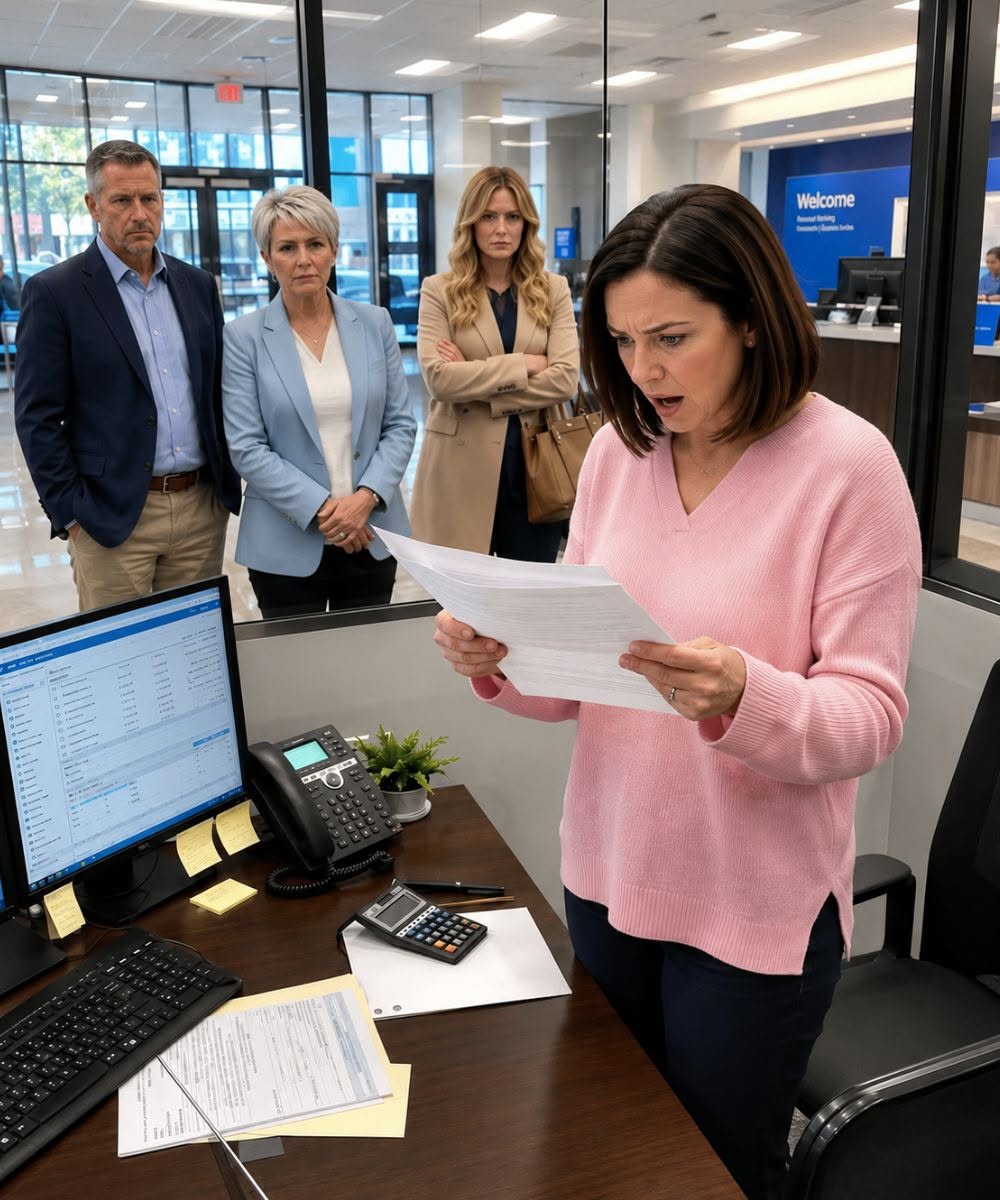
Then I looked back at my mother.
She had just admitted to a federal crime in the same tone someone might use to explain borrowing a casserole dish.
Richard did not even stand straighter.
He leaned against the glass wall and exhaled like I was wasting his morning.
“Don’t turn this into a legal drama,” he said. “We secured a bridge loan using your profile. We’ll pay the minimums until Chloe’s business starts making money. You’ll handle it. You always do. Now go into David’s office and authorize the release so we can continue with our day.”
Chloe finally looked up from her phone and rolled her eyes.
“Honestly, your credit utilization was basically zero,” she said. “It isn’t like you were using it. I don’t understand why you’re being so territorial.”
They believed a shared bloodline gave them permission to ignore federal law.
They believed the bank lobby was another family living room where they could control the story until I surrendered just to keep peace.
Then the frosted glass door opened.
David Sterling stood in the doorway, his expression formal and unreadable.
He looked at my parents, then at me.
“Sloan. Please come in.”
I walked past my father without saying a word.
The moment I moved toward the chair across from David’s desk, Beatrice tried to follow me inside.
“I need to be present for this meeting,” she announced, placing one manicured hand against the door frame. “I am managing this transaction, and my daughter is clearly confused about our family arrangement.”
David did not blink.
He placed his own hand against the edge of the door.
“Ma’am, you are not the primary account holder. If you step into this office, I will have security remove you from the premises.”
Beatrice’s mouth dropped open.
For the first time that morning, the mask slipped.
She stepped back.
David shut the heavy door with a sharp click.
Inside the office, the silence was complete.
David woke both monitors and turned one slightly toward me.
“I have the original digital application open. It was submitted online exactly twenty-two days ago. Because your corporate checking history with us is flawless, the system accepted an override code generated from a recognized profile match.”
The screen showed application fields, timestamps, and contact information.
“When our fraud team flagged the wire transfer last night, they tried to call the primary account holder for verification,” he continued. “But they did not reach you.”
I looked at the screen.
The name was mine.
The Social Security number was mine.
The birthdate was mine.
The contact information was not.
David scrolled to the primary contact section.
He did not point.
He simply let the information speak.
“Why is your mother’s phone number listed as yours?”
I stared at the ten digits.
It was not a typo.
It was the foundation of a trap.
They had not merely used my name.
They had redirected every security code and approval message straight to my mother’s phone so mine would never ring during the application process.
“Because she needed to intercept the approval texts,” I said.
David’s jaw tightened.
He opened another tab labeled identity verification.
“If the contact number was changed during the application to bypass the freeze, the system would have required visual secondary verification. A government-issued photo ID proving that you authorized the change.”
He pressed enter.
A scanned image appeared on the screen.
David stared at it for several seconds.
Then he looked at the legitimate driver’s license I had placed on his desk.
Finally, he turned the monitor toward me.
“Sloan,” he said quietly, “look at the address and the signature on this uploaded ID.”
I leaned forward.
The face on the screen was mine, pulled from an old photo.
But the address was not my home.
It was my father’s architectural firm.
And the signature at the bottom was not my handwriting.
“That’s my mother’s signature,” I said flatly.
She had not even tried to imitate mine.
Beatrice had been so protected by arrogance, so certain the world would bend around her convenience, that she had simply signed her own name on a fake state ID carrying my photograph.
David leaned back.
The polite branch director vanished. In his place sat a banking professional looking at a major compliance breach inside his own institution.
“This is no longer unauthorized family use,” he said. “This is synthetic identity theft and federal wire fraud.”
He opened the transaction ledger.
A list of red charges filled the second monitor.
Fourteen thousand dollars at a boutique interior design showroom.
Nine thousand at a luxury electronics retailer.
Six thousand at a high-end day spa.
Vendor deposits.
Retail purchases.
I thought of Chloe in the lobby, wrapped in that pristine wool coat with the designer handbag shining beside her.
They had not stolen my identity for emergency medicine.
They had not done it to stop an eviction.
They had stolen it to decorate a fantasy.
At the top of the ledger, one line was highlighted in yellow.
Status: hold pending fraud review.
Amount: $45,000.
Type: wire transfer.
“Where was the wire going?” I asked.
David clicked the routing details.
“The destination is a commercial holding account at Coastal Fidelity. Beneficiary name: Chloe Vanguard Interiors LLC.”
My sister’s brand-new interior design company.
The one my mother had described as having a “minor cash flow issue.”
Chloe had not only bought herself luxury items.
She was trying to fund an entire startup with my credit score, using my father’s firm as the delivery address.
“They spent fifty-five thousand on retail charges and vendor deposits,” David said. “Last night, they attempted to wire the remaining forty-five thousand directly into Chloe’s LLC for a commercial lease. Because the wire amount was large and the destination had no prior connection to your financial history, our system froze the account.”
They had not come to the branch at dawn to confess.
They had come to bully the bank into releasing the last of the money before fraud investigators reached me.
“David,” I said calmly, “print the transaction ledger. Print the application metadata showing the IP address. Print the high-resolution scan of the fabricated ID.”
He paused.
“Sloan, if I give you the complete fraud audit file, that formalizes the claim. The bank will be legally required to begin an internal investigation immediately and report the fabricated ID to federal authorities. Once I hit print, there is no reversing this.”
“I am not trying to reverse it,” I said. “I am the victim of identity theft. Print the logs.”
David nodded once.
The large printer came alive behind him.
The steady sound of paper sliding into the tray felt like a lock clicking shut.
PART 2
CONTINUE READING...>>
To see the full cooking instructions, go to the next page or click the Open button (>) and don't forget to SHARE it with your friends on Facebook.